When preparation may be suitable
Use this service when the supporting evidence is sufficiently established and a controlled technical summary is needed for New Zealand use.
Review the building-product evidence pathway ↗Building Product Technical & Compliance · PTS
AIBuild assesses and prepares the technical information for a manufacturer or supplier statement. The work sits within our building-product compliance service and is scoped to the product, intended New Zealand use and available evidence.
Discuss a Product Technical StatementEnglish technical deliverable
A controlled English technical statement covering the agreed product and scope of use, prepared from the information and evidence assessed within the engagement.
Definition and suitability
A Product Technical Statement is a controlled technical summary issued by the manufacturer or supplier. It identifies the product, its intended New Zealand use and limitations, relevant Building Code provisions, supporting evidence, and the design, installation and maintenance conditions associated with the stated use.
Use this service when the supporting evidence is sufficiently established and a controlled technical summary is needed for New Zealand use.
Review the building-product evidence pathway ↗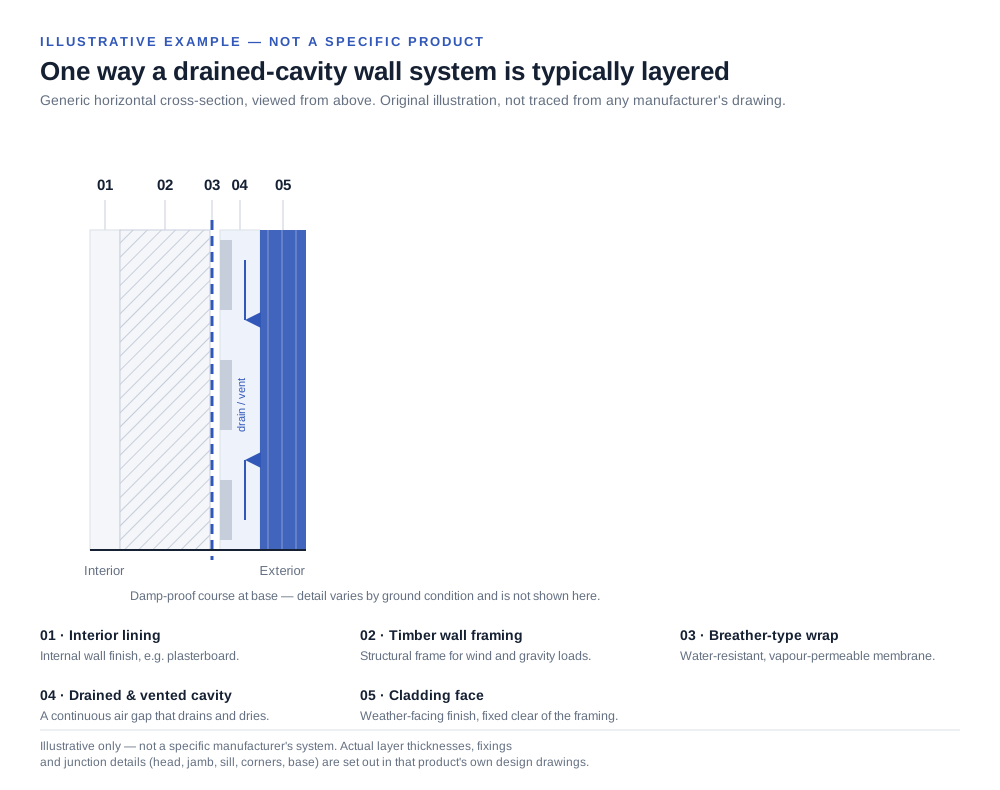
Generic build-up, for illustration only
The weather-facing finish — for example render, weatherboard or a metal panel — fixed clear of the framing.
A continuous air gap so that any moisture which gets past the cladding can drain away and dry out.
A water-resistant, vapour-permeable membrane fixed over the framing before the cavity battens go on.
The structural frame carrying wind and gravity loads; junctions are flashed where the cladding is penetrated or interrupted.
Illustrative only — not a specific manufacturer's system. Actual layer thicknesses, fixings and junction details are set out in that product's own design drawings and checked against the Building Code clauses below.
Process
Confirm
Confirm whether the evidence position is ready for PTS preparation.
Prepare
Assess the agreed material and prepare the controlled English statement.
Review
The manufacturer or supplier confirms the claims, scope and responsibilities before issue.
Detailed service information
Manufacturers and importers with sufficiently established supporting evidence
Suppliers and distributors responsible for communicating product scope and limitations
Developers introducing or supporting a product or building system in New Zealand
Designers or consent reviewers need one clear point of reference for product identity, scope and evidence.
Technical information is fragmented across test reports, data sheets and installation guidance.
The product has an established evidence position but its New Zealand scope and limitations are not clearly documented.
A supplier needs controlled issue and revision information for its technical statement.
Exact product, model or system identification and manufacturer or supplier details
Intended use and proposed New Zealand scope of use
Test reports, assessments, certificates, calculations and relevant technical data
Applicable overseas standards and the basis for their relevance
Design, specification, installation and construction requirements
Maintenance requirements, service conditions and consequences of non-maintenance
Known limitations, exclusions, warnings and technical support contacts
Product description and unique identification
Manufacturer and supplier details
Intended purpose, New Zealand scope and limitations
Conditions applying to use of the statement
Relevant Building Code clauses and compliance pathways
Links to the supporting evidence relied upon
Design, construction, installation and maintenance requirements
Technical support, issue date, revision and document controls
A PTS and BPIR are not interchangeable. A PTS is a voluntary technical summary used to organise a product's scope, claims and supporting evidence. BPIR sets information obligations for relevant New Zealand participants and designated building products. Where both apply, AIBuild can check consistency across the PTS, disclosure, technical data and published product information.
It is not certification, an appraisal, a laboratory test report or an approval by a Building Consent Authority.
It does not replace the evidence it summarises or remove the need to assess that evidence for the proposed use.
It does not mean overseas testing is automatically sufficient for New Zealand or that further testing will never be required.
It does not require a designer, Building Consent Authority or other project party to accept the product.
The manufacturer or supplier owns the PTS and remains responsible for the accuracy of product claims and information supplied.
AIBuild assesses and organises the agreed information; AIBuild does not convert the PTS into certification.
Designers and project parties remain responsible for deciding whether the product is suitable for a particular project and use.
Building Consent Authorities retain their assessment and decision-making responsibilities.
Specialist testing, engineering, appraisal or certification remains with the appropriately qualified provider.
A PTS does not replace the evidence it summarises and does not by itself prove Building Code compliance.
The applicability and sufficiency of evidence are product- and use-specific; further testing or assessment may be recommended.
AIBuild does not guarantee acceptance, approval or certification.
Laboratory testing, engineering certification, BRANZ appraisal and CodeMark certification are outside this engagement.
Send an email enquiry with a short description of the product, intended New Zealand use and current evidence.
We confirm whether evidence-pathway assessment or PTS preparation is the appropriate next step.
We issue a scoped proposal confirming the required information, boundaries and fee before work begins.
You provide the agreed technical documents and supporting evidence by email.
AIBuild assesses the material, records gaps and prepares the draft Product Technical Statement in English.
The manufacturer or supplier reviews and confirms product claims, scope and responsibilities.
The controlled English Product Technical Statement is issued and follow-up questions are handled by email.